

Does a Title Make You a Champion?
 By Anthony “Stacks” Saldaña
In the 1960’s boxing had one recognized sanctioning body the (WBA) World Boxing Association also known in the United States as the (NBA), The National Boxing Association. Boxing in the 60’s and 70’s began to take a back seat to other sports including baseball, football and basketball. The country had lost interest in boxing including high profile championship fights. With the lack of television ratings and Muhammad Ali being one of the few worldwide recognized fighters boxing promoters had to do something to maintain public interest, so they did two things. First they found reasons to break off and form multiple sanctioning bodies. Every weight division now had multiple boxers with a claim to the one of the titles. Second the sanctioning bodies increased the number of weight divisions from eight divisions to seventeen.
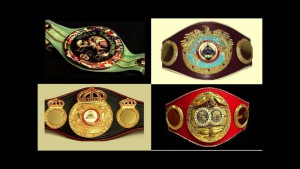
In today’s boxing scene any fighter, at anytime, can be a holder of one of the alphabet soup belts. On paper these fighters are considered a world champion. The IBF, WBO, WBA, and WBC are the main sanctioning bodies that award championships. Ring Magazine also awards championship belts. With so many sanctioning bodies most of today’s fighters are enabled champions, and allowed to cherry pick opponents from a padded pool of fighters. Great championship fights are few and far between.
For boxing promotion companies this is a business, point, blank, period “it’s all about the Benjamins”. A fighter makes his money from the purse. Although the boxer is the one taking the physical risk, promotional companies take the financial risk. Promoters put up all the money to make a boxing event. They pay for advertising, legal fees, and licensing to just to name a few. However, because of the huge financial risk that promotional companies take, they also make the most money from the fight cards. They often take most of a boxer’s purse, money made from any network or pay per view deal, as well the gate money.
With that being said styles, and marketability can make or break a fighter in today’s fight game. Fighters such as Guillermo Rigondeaux, and Andre Ward are two examples of fighters that are very hard to sell to a casual fan, and are two of the most technical champions in the fight game. Examples of a true champions being ducked. High risk low reward fighters.
Muhammad Ali credits “Gorgeous” George and professional wrestling in general for teaching him an important business lesson, “Personality wins fights”. By the end of the 1970s, Ali was making guest appearances on sitcoms and starring in his own Saturday-morning cartoon. Even now he remains the single-most famous figure associated with the sport. Although Ali was a true champion in the ring, his larger than life persona and marketability helped lay the foundation for fighters such as Floyd Mayweather, JR. to take low risk high reward fights. Floyd whose fights are flat out boring, used his villain persona and business smarts to define who he is today. Floyd is definitely not the only fighter or promoter guilty of this. In today’s boxing scene this is happening way to often.
A good example of this is a young prospect who has had a promising amateur career, his marketability potential is much higher than an unknown. So a highly-touted prospect may be eased through his first ten to twenty fights, never forced to face a fighter that test his skills, chin or heart. This can be a blessing or a curse for a prospect, due to boxing politics these fighters usually find themselves ranked by several sanctioning bodies. This can be a recipe disaster as they’re put into fights they’re not prepared for. A boxer may have never tasted the power of a world class opponent until it’s on a very unforgiving world stage and they’re exposed. The same go for paper champs. A title and belt from a sanctioning body does not make a fighter a champion, it makes them a title holder. Real boxing fans know who the true champions are. Many time these fighters are labeled the “People’s Champ”. True champions are a dying breed lost in the greed and politics that have taken over boxing.
[si-contact-form form=’2′]