

Ringside Report Looks Back at Boxer Dave McCleave
By Donald “Braveheart” Stewart
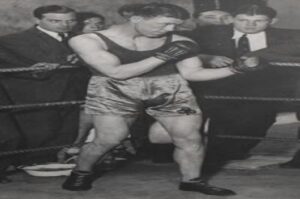
There is grainy footage online of Dave McCleave, 77-26-3, 25 KOs, in the gym in the 1950s with a bunch of boys. It shows him, slicked down hair, his frame not the tailored and taught one we would expect from a prizefighter of today, but the discipline of the time is very prevalent. Given that the boys were being tutored by an Olympian, it is little wonder they appear in awe of him and well-schooled by him.
His glory days, now well behind him, he became one of those heroes of the sport who gave back in equal measure to what he took away. But what a career he gave us.
His amateur record was a stellar one. A British Empire Games gold medalist in 1934 (it was many years away from transitioning into the Commonwealth Games), by beating South African, Dick Barton in the final, he was already the British Amateur Boxing Association (ABA) champion for 1934, having been surprisingly put out in the semifinal by J. P. Barry in 1933.
He had boxed for England against Ireland in 1932, which was the same year he represented Great Britain in the Olympic Games losing the welterweight bronze medal match to Finland’s Bruno Ahlberg – he was unable to fight, and it was recorded as a walkover win for the Finn. He had beaten Al Romero in round one, then Lucian Laplace in the quarter final only to lose to American and eventual gold medalist, Eddie Flynn in the semi. In the Los Angeles games there was no automatic bronze for defeated semifinalists, so he returned with stories and an experience rather than a bauble. But what need did he have of Olympic jewelry as he had already managed to achieve a 1932 win at the ABAs, having won it in 1931 too. McCleave was also the European amateur champion when in 1934, he beat the Hungarian István Varga.
So an Olympian, British Empire Games gold medallist, European amateur Champion and three times Aba champion – not bad for a four year run at it all for this Londoner, born and bred, who grew up through one world war and then went on to serve in the second as a PT instructor.
He also had an 11-year professional career which added to the 4 years as an amateur. In that professional ring he won one domestic title, as he became the British welterweight champion in 1936, though he lost it in the same year. These were his only two national title fights, but he had a special relationship with the Southern Area title!
McCleave’s professional career was blighted by one thing – the war. He turned professional of the 23rd of September 1934, in Southwark, London when Tommy Marren gave him his first win by retiring after the 5th round.
Just under a year later, on the 1st of July, 1935, in Liverpool, he met Ernie Roderick in a semifinal British title eliminator, losing on points over 12 rounds. He was close to a national title less than one year after turning over, which says a lot about his prowess but also, perhaps about the lack of opponents as were heading towards a war. Losses were to feature on his record as he was again beaten in the same year, this time on the 18th of November in Norwich when he lost the Southern Area welterweight title on points against Arthur “Ginger” Saad.
It was his first fight for the Southern Area title which, as it suggests, covers the south of England – including London. In the days of not being able to travel quite as easily as we do now, the area titles became much sought after and had a cache that they perhaps no longer have, but if you wanted to follow boxing career, at this the there was a proper way to do it and this was the pathway that McCleave was going to follow.
Back in Norwich on the 20th of January in 1936, he was to win the damn thing for the first time – by beating Arthur “Ginger” Sadd on points! From there it was the British title, and on the 23rd of April 1936, he faced Chuck Parker in Kensington London and became British welterweight champion on points.
On the 2nd of June 1936, he travelled to Glasgow and at Shawfield faced Jake Kilrain who knocked him out in the 8th round – his reign as British champion was over.
But Britain was facing a much bigger fight as the shadow of war hung over every aspect of life. People were less prepared for sporting prowess than discussing the likelihood of going back into conflict with Germany.
The number of active boxers was going to diminish. The opportunities to fight for anything outside of your borders disappear. And names on your resume were likely to repeat. And so, it was for McCleave who fought Freddie Mills three times in two years – ‘38 and ‘39 1 win on points, 2 defeats by knockouts. Two fights with Dick Turpin in the ‘40s – a loss in Birmingham and a win in Coventry. Arthur “Ginger” Sadd even made a return when he boxed McCleave in a British middleweight title eliminator at the Royal Albert Hall on the 3rd of November 1941. McCleave lost when he was stopped in the 8th round.
He was to fight for the Southern Area title twice during the war – both times at middleweight. He won it in 1941, outpointing Eddie Maguire at the Royal Albert Hall. The second time, on the 23rd of August, 1944 he was stopped in the 5th round by Vince Hawkins at the Queensberry Club in Soho for the Southern Area title in a fight that doubled as a British middleweight title eliminator.
His final fight, on the 1st of October 1945, came after hostilities had ended and peace had been declared. But in Luton, on that night he stopped Trevor Burt to record his final win. Between the two of them they had fought over 170 professional bouts!
After he retired from the ring he became a publican, as the landlord of the Union Tavern Pub in Camberwell, London. In the back room he ran that boy’s boxing club, and it is from there the footage online comes. Here he was to be seen running the club with the 1935 featherweight champion, Edward “Tiny” Ryan. McCleave moved from that pub some time in the 1960s to run the Tulse Hill Hotel – but there was no back room available for him to continue with boys’ boxing.
On the 19th of May 1988, McCleave left us, aged 76.
His professional career, severely curtailed by a war, nevertheless needs to be remembered. 106 professional fights, 4 distinguished years as an amateur, a British Empire Games gold medal and fights at an Olympics in the shadow of a conflict to come. History marks people out, and we should never forget those who deserve the merit of being in the wrong place with the right attitude.
Click Here to Order Boxing Interviews Of A Lifetime By “Bad” Brad Berkwitt