

Historic, Vintage, Cool (Spain)
By Karen Beishuizen
I have this thing for anything historic, vintage or cool. Especially when it comes to hotels, restaurants, diners, cafes and music venues. I want to show you landmarks around the world which are Historic, Vintage and Cool.
We are in the city of Antoni Gaudi: Barcelona!
Casa Milà or La Pedrera
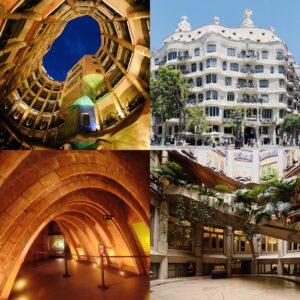
Casa Milà, or commonly known as La Pedrera, is a Modernista building in Barcelona. It was the last private residence designed by architect Antoni Gaudí and was built between 1906 and 1912.
In 1905, Milà and Segimón married and on June 9, Roser Segimón bought a house with garden which occupied an area of 1,835 square meters, located on Paseo de Gracia, 92.
In September, they commissioned Gaudí for building them a new house with the idea of living in the main floor and renting out the rest of the apartments.
On February 2, 1906, the project was presented to the Barcelona City Council and the works began, demolishing the pre-existing building instead of reforming it, as in the case of the Casa Batlló.
As visitors step into the entrance hall of Casa Mila, they are immediately greeted with a breathtaking sight.
The sweeping staircase, bathed in natural light from the skylight overhead, is a stunning feature that draws the eye.
The hall’s arches and columns are not just decorative elements; they serve as essential structural supports, bearing the weight of the building. This space serves as the central hub of Casa Mila, making it a popular spot for visitors to begin their tour. The large, wooden doors that lead into the entrance hall add to the building’s overall grandeur and highlight the attention to detail present in every aspect of Gaudí’s design.
The rooftop terrace of Casa Milà is undoubtedly one of the highlights of this iconic building. Accessed via a series of winding staircases, visitors can take in stunning panoramic views of Barcelona’s skyline.
The rooftop is adorned with a series of stone carvings, depicting various themes, from nature to mythology, and the four elements. The chimneys on the rooftop are a particular highlight, featuring unique shapes and intricate patterns. These chimneys have become an emblematic symbol of Casa Milà, representing the building’s unique and innovative design. Visitors can’t help but be captivated by their quirky, soldier-like appearance.
The rooftop terrace is a popular spot for tourists and locals alike, with ample space to soak in the views and snap some memorable photos. It’s an ideal spot to unwind and take a break from the hustle and bustle of the city, while basking in the stunning architectural and natural beauty of Barcelona.
The central courtyard of Casa Mila is a oasis amidst the hustle and bustle of Barcelona. Surrounded by private apartments, this serene space is adorned with a range of exquisite artworks that embody the Catalan Modernista style.
Visitors are greeted by a series of captivating mosaics, murals, and plaster reliefs that adorn the walls of the courtyard. These stunning artworks depict various themes, including nature, mythology, and the four elements, further adding to the courtyard’s beauty. In addition to the art, the courtyard is also decorated with a collection of intricate stone carvings, each telling its own story. The interplay between the art and the stone carvings creates a harmonious atmosphere, making the courtyard a peaceful haven for visitors.
Despite its central location, the courtyard of Casa Mila is an oasis of calm, providing a tranquil retreat from the lively city outside. It is a place of inspiration and contemplation, allowing visitors to connect with the beauty of the natural world and the art that celebrates it.
Nestled in the basement of Casa Mila, a lesser-known but remarkable feature awaits visitors. The small indoor swimming pool, decorated with colorful tiles, is a unique and unusual addition to the building’s design. Interestingly, the pool was not part of the original plans and was added later in the mid-20th century when the building was converted into apartments. Despite its relatively small size, the pool is a special and rare feature that distinguishes Casa Mila from other residential buildings. The pool area includes several small changing rooms and showers, creating a private and intimate space for residents and their guests. Although the pool is not open to the public, those lucky enough to experience it will undoubtedly appreciate its unique beauty and the building’s rich history.
While the private apartments on the upper floors are not available to visitors, several other parts of Casa Milà are open to all.
The Espai Gaudí, an homage to the architect, is located in the attic; this exhibition offers insights into Gaudí’s life and work through models, photographs, and videos.
Other open rooms include the Pedrera Apartment (a recreation of an early 20th century apartment, showcasing the lifestyle of the building’s original residents) and the rooftop terrace.
All are a must-see, and guided tours are offered, as well as night tours.
In 1984, it was declared a World Heritage Site by UNESCO.
Since 2013 it has been the headquarters of the Fundació Catalunya La Pedrera, which manages visits to the building, exhibitions and other cultural and educational activities at Casa Milà.
For more info, check out Casa Mila’s website: Here
Click Here to Order Boxing Interviews Of A Lifetime By “Bad” Brad Berkwitt