

1980s TV Shows: A Trip Down Memory Lane with… Marc Singer (Mike Donovan in “V”)
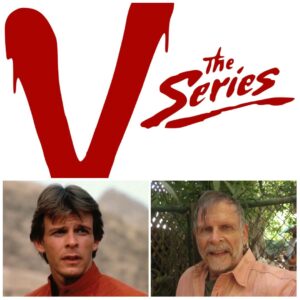
Exclusive Interview by Karen Beishuizen
“V” was an American science fiction series that aired on NBC from 1984 to 1985. It ran for 19 episodes. The show followed a two-part miniseries which was aired in 1983 and a three-part miniseries “V: The Final Battle” in 1984. It was the story of an alien invasion of Earth by reptilians known as “Visitors”. Marc Singer played human Mike Donovan and Jane Badler played one of the visitors.
KB: “V”: What kind of show was it?
“V” as originally conceived was a veiled reference to fascism’s insidious appeal to those with something to gain or nothing to lose. Every society has those disaffected “in-betweeners” as well, who simply seek to give meaning to their lives by joining a movement for the sense of purpose it gives them – regardless of its factual record, or deleterious effects. At least in the beginning this was its purpose. Later I believe, it became more adventure oriented, a strong element ever- present, in either case.
KB: How did you get the part as Mike Donovan?
I feel sometimes that it was less that I auditioned for the role of Mike Donovan than that I was picked to play him. The creator of “V” was – I believe – aware of my work as Petruchio in the live, on-stage production Shakespeare’s “The Taming of the Shrew” (which I believe can still be accessed on the internet) and my leading role as “The Beastmaster” (that film), and I guess he was convinced, because it seemed to me that my path took a shortcut from these to playing the de-facto lead in “V”.
KB: What did you like about the character and how did you make it your own?
Every actor makes every character his or her own by the mere assignment of the part. For me, then, Mike Donovan represented a kind of ‘everyman’ who was thrust unwillingly into his pivotal role by the powerful nature of his own truth, his unspoken, unadmitted dedication to morality. He was not a hero by choice, or even inclination… he simply felt he could not stand idly by. I think these are the qualities of self-sacrifice and service so many aspire to, and the thought, that maybe I could represent it, struck a chord in me.
KB: It was supposed to be a 2-part mini-series but then a TV show followed. Were you surprised it got picked up by a network?
After the mini-series’ astounding ratings, I was not surprised at all. Pleased, but not surprised. I knew there was a lot of work yet to be done and that ratings, represented in that sense, is a responsibility, not a reward. I went to work for the team, and made sure to contribute to that ethic as the standard for how the ‘acting department’ carried out its responsibilities – as a part of the larger team effort. And for the most part, I think we succeeded. I was proud of my colleagues. I was honored to be in their company. I’m proud of them to this day.
KB: What did it look like on the set from getting the script to filming?
As I recall, when the show went to series, we always tried to start with a ‘table read.’ It gave everyone a sense of context, how the story was going to unfold and what our individual contributions would be. From then on out it was a 4 am wake-up and a sixteen-to-eighteen-hour day (my longest was twenty-two hours) until the bed rose up and smacked you in the face and it became another 4 am wake-up before you knew it. In between, there was sliding cars across the pavement, jumping through windows, clambering over obstacles, leaping down stairways, choreographing, rehearsing, and executing stunts, learning and editing lines, horses to gallop, and scenes with an ever-changing panoply of actors to shoot.
KB: Where was the show filmed?
“V” was filmed on the historic Warner Brothers lot in Burbank, California. On every street corner within its walls stood a building, a set, a parkway, a street that you had seen in movies when you were a kid. Sets that had seen every great star in film history walk through their doors or utilize their walkways since Hollywood’s establishment as the film capitol of the world. And when not on ‘the lot’ we would be in film sets on ‘movie ranches’ in various locations in the surrounding hills and deserts, or downtown in L.A. itself.
KB: Do you have a favorite episode?
Every episode presented a challenge and a reward. They were all engrossing, and meeting the constant need to fulfill the moments in each blurs the distinctions sometimes. But what I enjoyed most was walking in the footsteps (figuratively speaking) of great creative artists like Buster Keaton and thinking: “What might Buster do when trapped in a situation like the one in this episode?” I set my personal standard high, that way, and tried to honor the greats of Hollywood’s legacy
KB: What is the legacy of “V” and its franchise?
Being a part of Hollywood history in a given era was “V”’s destiny in both the short and long run, what the future holds is beyond prediction. History outside the walls of the ‘dream factory’ is laid down as the aftermath of time and tide’s inexorable advance, however, and the lessons inherent in “V” may in time need to be relearned. Who can say?
KB: Looking back now would you have played Mike Donovan differently?
Yes. But that is the effect of age and experience speaking. At the time I worked as hard, gave as much, and gleaned as much as each moment afforded. Hopefully, we – all of us and each of us -grow more proficient at what we do as we progress in life, and this naturally deepens and broadens our experience, our expertise and – hopefully- our empathy, so there’s no doubt that this would show up in the work.
KB: How do you explain that “V” is still beloved after 40+ years?
A good show is a good show. Plain as that.
Click Here to Order Boxing Interviews Of A Lifetime By “Bad” Brad Berkwitt