

Q&A With Steve Luongo
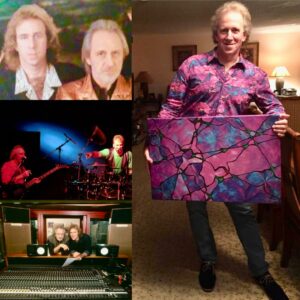
Exclusive Interview by Karen Beishuizen
Photos courtesy of Steve Luongo
Steve Luongo is an American drummer, singer, songwriter, fashion designer and record producer. In 1968 he founded the New York-based rock group Rat Race Choir. He is a pioneer of electronic percussion and performed extended drum solos on a massive kit including a prototype of the Moog Synthesizer Drum. His trademark move was drumming with one hand and both feet while playing in time along with a mechanical toy monkey held up in front of a microphone with his free hand.
He met The Who’s bassist John Entwistle in 1987 and they were friends and toured together until John’s untimely death in 2002. Steve was asked to write and deliver the eulogy at the memorial service held in London. He directed and produced “An Ox’s Tale-The John Entwistle Story”. As a fashion designer he creates limited edition prints named, numbered, and signed using his art printed full scale on a luxurious cotton fabric complete with signature, etched buttons, and embroidered details. The Steve Luongo Project is a trio with Angus McEachern on bass, George Harris on guitar and Steve on drums. He is working to get a musical residency in his home state Florida.
KB: Did you always want to be a singer and musician growing up?
As far back as I can remember, I was always artistically creative. I loved art and music. My mother played piano, classical and popular songs. She would sit down and play “Für Elise” or “The Autumn Leaves”. She also had a diverse record collection everything from Mario Lanza to Benny Goodman. My brother was eight years older than me and his musical taste ranged from Elvis and Johnny Mathis to Brazil 66. I always knew that music would be a part of my life.
KB: What age did you start playing drums and why this musical instrument?
My musical direction was set in kindergarten when the high school band performed in our elementary school auditorium. The minute the drums echoed in the large room, I turned to the girl next to me and declared “that’s what I’m gonna do for the rest of my life.” So far it seems to have worked out. Singing happened later. I didn’t necessarily want to be the only singer, but I loved The Everly Brothers and loved singing harmony. Eventually, I began singing lead as well, but these were things that happened rather than desires to be fulfilled.
KB: You founded Rat Race Choir in 1968: The band dominated the New York tri-state music scene in the 70s and 80s. Describe that time to me and what is your fondest memory?
My first rock ‘n’ roll dream was to play at a local club in White Plains, NY called the Fore ‘n’ Aft. We played anywhere we could from Catholic girls schools, CYO dances, even the Westchester County penitentiary.
When we got an agent we started getting better gigs. I was 16 when we finally managed to get a gig at the Fore ‘n’ Aft. Playing the Aft was the first of many milestones in my career.
KB: Your trademark move was drumming with one hand and both feet while playing with a mechanical toy monkey held up in front of a microphone with your free hand. How did you come up with this?
When Cream released Ginger Baker’s epic drum solo “Toad” in 1966 it inspired me to create my own lengthy over the top drum solos. I was always looking for props to use in my solo. Something unique to differentiate my elaborate percussion pieces from others who had come before me. I would stop at a toy store or a hobby shop and pick a prop to use during my drum solo. I tried lighting my cymbals on fire, putting glitter on my snare drum. Blowing into a vinyl hose in the air hole of my snare to change the pitch of the drum.
The props turned into part of the solo. This took on a life of its own. One day in 1970, I was in a music store and the salesman said take a look at this. He pulled out a small black drum with a cable and knobs on the side. It was the prototype Moog drum that connected to a Mini Moog. Rat Race had 2 Mini Moogs. This was the dawn of electronic percussion. I used it as the climax of my drum solo. I would play in time with a sequence created by the drum that gradually sped up and brought the solo to a climax. It became sort of a signature for me.
In the early 70s a waitress at one of the clubs we played gave me Zippy, a mechanical monkey that played the drums. It was amazing. His feet played the high hat and kick drum while his hands worked the ride cymbal and snare. He’s playing a proper beat, and I got the idea to hold him up and play along with him. I had a vocal mic on a boom stand with a gooseneck. My roadie would move it in front of me. I would hold the monkey up with my left hand pressing his kick drum up to the mic. The audience could hear the beat through the PA as I played along with him using one hand and both feet. This led me into the synth bit and the solo climax. Adding the monkey turned out to be another signature for me. The best part was girls who would normally ignore the drum solo were now enchanted by the cute little creature being displayed on stage.
KB: John Entwistle and you were best friends. You toured together with The John Entwistle Band until his untimely passing in 2002. How did you meet? What is your fondest memory of John and how hard was it to write the eulogy and read it at his memorial service?
I met John in June 1987 at the NAMM show in Chicago. This was a music convention held twice a year in the states. Our front of house sound mixer Joe Berger had just returned from a similar convention in Germany where he jammed with John Entwistle. He told John about RRC and suggested that we meet in Chicago. The Who had not performed since the early 80s and John who lived for life on the road was musically frustrated looking for a musical outlet.
When we met the first thing I said was “Do you want to jam?” and he replied “Anytime mate”. I took that as a license to steal. I went into the convention and discovered that Kramer Guitars were hosting the All-Star jam which would be the pinnacle of the convention. Armed with Entwistle’s permission and a creative use of the facts I secured Rat Race Choir and John the premier spot in the concert.
He had no idea that we would be performing at the Vic Theatre in downtown Chicago for thousands of fans. He asked me what we were going to play and I replied “Who songs” and he said “I don’t know any”. I told him not to worry that we would teach them to him. We played four songs from The Who Live at Leeds. The place went nuts. From that moment on a business partnership and life altering friendship was born. In the 15 years that we worked together we were business partners, bandmates and absolutely the best of friends.
When he passed away in 2002 I got a call from The Who’s manager, Bill Curbishly, who said the boys in the band along with John’s family would like you to write and deliver the eulogy at John’s Memorial service in London. Of course I accepted. It seemed like it took forever to write it. I received a lot of guidance from his son Chris and his mother AC Queenie. They shared stories that no one else would know. The rest came from my own experience. The memorial was held in Trafalgar Square at Saint Martin’s in the Field. The place was filled with rock royalty. This was one of the greatest honors of my life and the most difficult public performances I have ever done. I closed the eulogy by saying “When it thunders think of John Entwistle.”
KB: “An Ox’s Tale-The John Entwistle Story”: What made you direct and produce this documentary and how proud are you of this?
I received a call from a filmmaker inquiring about doing a film for the John Entwistle Band. At that time, John was preparing for a tour with The Who. I rang him up with an idea. “Let’s shoot a documentary type film about what it’s like to gear up and prepare for a world tour with one of the biggest bands on the planet. Like a soldier dusting off his guns and uniform and going back out to war”. He agreed that it would be fun and we shot 10 hours of us talking about the process along with footage of set ups and rehearsals. John even came up with the name “An Ox’s Tale.”
I returned to NY from England with the footage and then left for Burbank, California to edit the film only to discover that the financial group had run out of money. I would not be editing at one of the big Hollywood studios. I was sequestered to a storage locker with an amateur editing suite. This was completely unacceptable. I had an iron clad contract which gave me complete control. I took my masters and returned to New York. The project was “left for dead.”
Years later after John had passed away, I received a call from a film company in California asking me if I knew anything about the 10 hours of interview footage that was being offered for sale. Someone had copied the tapes and was shopping them in Hollywood. With my contract in hand, I was able to halt this immediately however, as a result, I began a conversation with this film executive. And wound up completing the film as a posthumous piece. Instead of a documentary about heading back out on the road it became a story about one of the most iconic musicians in modern music.
I called several friends, inviting them to take part in the film and tell stories about Entwistle. Pete Townshend, Chris Squire, Ray Manzarek, Roger Glover, and Chris Stamp were among a long list of friends that contributed to the film along with narration by Peter Frampton. I was criticized by Stamp for not including the alcohol and drug use, but my intent was to highlight the indelible contribution that John made to rock music. I’m extremely proud of what I did without using scandal or rumors to propel it.
KB: What is The Steve Luongo Project?
I have been a professional musician since the age of 13. It is the only thing I’ve done in my life. I never wanted to be a solo artist. I have always had the need to create music with a group of talented people. The Steve Luongo Project is simply a continuation of that need. The project is a trio with Angus McEachern on bass and George Harris on guitar. Once again, I’ve been blessed with incredibly talented bandmates who share my vision. It’s a power trio focusing on the classic rock of our youth. I have toured the world with some of the most talented people in the business. I am currently negotiating a residency that will allow me to perform in concert regularly in a fixed location not far from my home in Florida.
KB: “TorQue 103103”: Why is this one of your proudest musical achievements?
Rat Race Choir was a musical force that gained a legendary status for its musicianship and diversity. We inspired countless musicians who went on to have stellar careers. RRC never commercially released the music that we created. We did an independent release of a 45 in the early 80s but I never believed it represented the true sound or creative ability of the band.
“TorQue 103103” is the closest thing to the musical spirit of the original Rat Race Choir. I assembled a band that I believed to be up to the task and wrote the entire album with Rat Race Choir guitar prodigy Mark Hitt. I produced the recordings that were engineered by Jim Roberts who helped bring this vision to life.
It is one of my proudest musical achievements.
KB: Your artwork and your fashion line with your art on it: How did this all started, what kind of art do you create and describe your love for art to me?
Throughout my life, it has been my natural drive to create visual or musical art. Over the years I’ve worked in many visual mediums. From pencil to ink and acrylic on canvas. Not long after John Entwistle passed away my wife and I relocated to Florida. A friend who was an art aficionado saw some of my art and suggested that I show my work in galleries. I have always tried to walk through the doors that were open and this seemed like a logical progression. I did the art show circuit for a couple of years. I realized it was not for me. But the reaction to my art was amazing. I sold well and I was shown in some prestigious events.
It was suggested to me that my abstract art would look great on shirts. I did not want to do T-shirts with abstract art plastered on the front or back, so I decided to create limited edition prints named, numbered, and signed using my art printed full scale on a luxurious cotton fabric complete with signature, etched buttons, and embroidered details. Only 20 numbered pieces in each size. Truly limited edition. I like to think of myself as an innovator so it occurred to me that using my art as a limited edition fashion art print on a garment would follow that thinking.
Many of my celebrity friends wear them on stage and screen. It’s been an unexpected journey, and I’ve learned a lot since turning my attention there. I have always loved creating visual art, and I use it as a means to decompress from music.
KB: What are you currently up to?
As I said earlier, I am working on the Steve Luongo Project for a musical residency, but my current passion is scale racing. These are eighth-scale and 10th-scale race cars, some powered by nitro, others by battery. They are not the toys you buy at Walmart. It’s a professionally sanctioned worldwide sport with a very serious competition. Seven-time F1 world champion Lewis Hamilton started with RC, then carting, and so on.
I’ve been bashing RC cars for 20 years at construction sites just for fun, but for the past year, I’ve been into the hard-core racing, building my cars, tuning my motors, and doing my own set up. It’s an amazing sport and a great community of people. The simple answer is fast cars and rock ‘n’ roll.
Check out Steve’s website: HERE
Click Here to Order Boxing Interviews Of A Lifetime By “Bad” Brad Berkwitt