

Animal Stories Across The World… The Cairngorm Reindeer Herd in Glenmore, Highlands of Scotland
Exclusive Interview by Karen Beishuizen
Photo Credits: Alex Smith, Hen Robinson, John Paul and Neil McIntyre
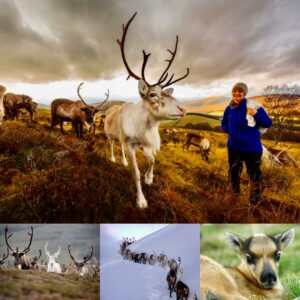
The Cairngorm Reindeer Herd in Glenmore, Scotland is a herd of around 150 reindeer. Reindeer are herbivores and eat a wide range of vegetation. This includes grasses, herbs, sedges and tree leaves. Their favorite food, and the most important part of their winter diet, are lichens. The reindeer spend night and day out on the mountains, all year round. They are very hardy and can survive temperatures below -60C, so the Scottish climate is no challenge to them. During Christmas the adult male reindeer are pulling the sleigh and the staff takes them out to visit people in towns across the country. They run guided Hill Trips onto the mountain so visitors can meet and walk among the herd, and also a volunteer program where folks can spend a week working alongside the herders and the reindeer, helping with the daily tasks and getting an insight into life with the herd.
KB: A herd of reindeer in Scotland: Have they always lived here? Where are they coming from?
Reindeer are a native species in Scotland but died out here several thousand years ago. Our herd were reintroduced in 1952, from Scandinavia, and are the only herd in the UK to roam free in their natural habitat.
KB: How many reindeer are there? Male and Female? and what are their age?
We maintain a herd of around 150 reindeer, with an even split between male and female. Our herd are a managed herd, so we control the number by controlling how many breed each year. This means we don’t need to cull or sell our reindeer – they all live out their natural lifespan with us. Reindeer live a similar length of time as a dog, so 13-14 years is average. The record in our herd is held by a reindeer named Lilac, who lived to 19 years old.
KB: What do reindeer eat?
Reindeer are herbivores and eat a wide range of vegetation. This includes grasses, herbs, sedges and tree leaves. Their favorite food, and the most important part of their winter diet, are lichens, which grow in among the heather on the mountains and on the bark of trees. We also supplement their diet with a carefully blended dry feed.
KB: What does your day look like managing a herd of reindeer?
Our year is very varied. In winter, the whole herd is roaming free, so if the weather is bad we don’t necessarily manage to find them. They are completely self-sufficient on the mountains so don’t need us! We do like to check the herd every day though and also run guided Trips onto the mountain so visitors can meet them. In spring we have the excitement of meeting the new calves, who are born in May, and in the autumn we work closely with the youngsters, gaining their trust through food bribes so they become confident approaching us and being handled. This is vital for future veterinary care if they ever become unwell, and enables us to move the reindeer to good areas of grazing.
KB: Where are the reindeer at night?
The reindeer spend night and day out on the mountains, all year round. They are very hardy and can survive temperatures below -60C, so the Scottish climate is no challenge to them.
KB: Are the reindeer happy and how can you tell?
Yes, our reindeer are very content. They are relaxed and happy around humans – they see us as a source of food and have no fear of us. They will continue to lie down and chew the cud even around groups of visitors. As a prey animal, this is a vulnerable position to place themselves in, so shows confidence in their surroundings. They always live in a group with other reindeer with lots of space to roam, as they should, so are able to express all of their natural behaviors.
KB: Christmas and people say Rudolph: Do you have an event during that time with Reindeer involved?
Our adult male reindeer are trained to pull the sleigh and we take them out to visit people in towns across the country. We always travel them in a group with their friends and they seem to enjoy a change of scene. At the end of the event, they come back to their mountain home.
KB: What are the Hill and Paddock trips?
We run guided Hill Trips onto the mountain so visitors can meet and walk among the herd. For those unable to make it onto the hill, we have recently completely renovated our Visitor Centre in Glenmore, so everyone can meet a few members of the herd here. This group spends a few days here before rotating back onto the mountain with the rest of the reindeer, and we pick a different group of reindeer to take a turn in the Paddocks.
KB: Can people volunteer?
We run a volunteer program where folks can spend a week working alongside the herders and the reindeer, helping with our daily tasks and getting an insight into life with the herd. This is very popular and books up quickly each year, with some volunteers returning for several years.
KB: How can people help to make sure the reindeer stay there and don’t extinct?
All income from visits, the shop and our adoption scheme goes towards maintaining our herd of reindeer here in Cairngorm, allowing us to provide for their needs and veterinary care. So anyone who visits or supports our work is supporting the life of our reindeer here. We’d also ask that visitors to the area who have a pet dog are careful to keep it under close control when walking in the mountains, for the safety both of our reindeer and of the wildlife. Unfortunately whilst we love dogs, the reindeer sees them as a wolf – their natural predator – and are very scared of them.
For more information or how you can help, check out The Cairngorm Reindeer Herd’s website: HERE
Click Here to Order Boxing Interviews Of A Lifetime By “Bad” Brad Berkwitt