

Q&A With Singer & Musician Joey Stuckey
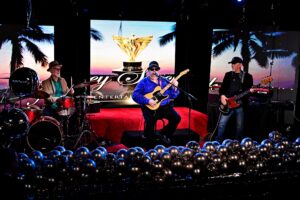
Exclusive Interview by Karen Beishuizen
Photos courtesy of Joey Stuckey
Joey Stuckey is an award-winning artist, producer, and speaker. Blind since early childhood, he learned to play instruments, to compose songs and to perform the music. He shared the stage with James Brown and Bad Company and runs his own music studio where many greats have recorded their albums. Joey will be performing at The Whisky A Go Go on 25 June. So if you want to see him Live, get your tickets via the link on the bottom of this interview!
KB: Did you always want to be a singer/musician growing up?
I am a blind brain tumor survivor, and as a child was very ill, so really my focus was on survival and not any kind of real extracurricular activities or future plans. However, music was always a big part of our daily lives and my house was filled with it. My dad played guitar and loved listening to music and my mom sang in the choir at church and also loves listening to music. So we were always joyfully aware of the beauty that music brings to people‘s lives. Without really understanding what I was doing, I was always using music as a source of solace, inspiration and comfort.
In my early childhood days, I obviously listened to whatever my parents did which in my dad‘s case was country and my mom‘s case either church music or classical. As I got older, I discovered other genres. One of the most prevalent memories I have is of my mom buying me a copy of the Beatles album “Yesterday… and Today”. She actually bought it on Mother’s Day one year when she ran into the store to pick up something to take to my grandmother‘s house. back then, the local grocery store have a very limited collection of vinyl records near the front and Mom knew who the Beatles were, though she wasn’t particularly a fan, but my parents worked hard to expose me to everything they could, and to make sure I have the opportunity, even as a sick blind child, to explore the world around me in whatever capacity I was able. So my mom picked up this record because she thought that I should know who the Beatles were and be exposed to their Sound since they were such a big part of the Zeitgeist.
That record was one that I played constantly and in particular when I wasn’t feeling well It always made me happy. Later as my health improved in my teenage years around 16 or 17 I realized that music was what informed my spirit and that it was a necessary part of my existence and me feeling complete as a human being and moreover, that I had a story I wanted to tell and music was the vehicle to do that.
KB: You are blind since early childhood: How did you learn to play instruments and the music notes?
Not being able to read music can certainly be an issue, especially if you want to do what I do which is producing albums and work as a session musician. However, not being able to see makes reading standard notation impossible, even though my first music teacher taught me how and describe the page to me. In addition while there is braille music, no one around my area taught it and even if they had you have to use both hands to read so you can’t play and read at the same time. I believe that we all have natural gifts and talents, and we should nurture those and lean into them. My gift has always been more about mental acuity and I have an excellent memory. So my first music teacher, Terry Cantwell, trained my mind and gave me a deep knowledge of music theory and used my good ear to maximum advantage.
Later when I attended music school this early training was really important and was what allowed me to make good grades and stay competitive.
It’s important to note that when I went to college the first time there was no such thing as the Americans with Disability act so we had to be inventive, flexible and patient. Terry changed my life in many ways and I love him as a brother. He gave me all the tools I needed to explore music and to perform it and compose it in a profound way. So my path was not the standard one of most professional musicians, but I am able to perform and write at a competitive level. That being said, some genres are more difficult to perform without being able to read a chart. So though I was actually trained classically, I do not perform much classical music.
I am able to do it, but the amount of preparation it would take for me to memorize all the sheet music, etc. is not a good return on my time from a business perspective so I tend to perform in genres that prize improvisation, attitude, etc., like jazz and blues, where my gifts are more powerful. That being said, I play on peoples albums all the time in every genre imaginable and really due to the rigorous training of my mind, and musical theory and the natural ability of my ear they present no problems. I’m able to execute my work as quickly as my sighted counterparts etc.
KB: How would you describe your music?
That’s an interesting question and one that’s actually very hard to answer in some ways and very easy to answer in others. My spirit is naturally eclectic because I have a curious mind and find the world an engaging and fascinating place. I’m curious about almost everything! And as someone that considers himself an artist, I feel strongly that I should not be limited in my ability to create, and that I should be able to use anything that excites or interest me in the creation of my art. However, we live in a world that likes to put things in boxes and from a marketing standpoint traditionally people have found that to be very effective. The difference in today’s music business and the music business that was in play when I first started is profound and an entirely different conversation that I could wax philosophical about for pages. But the key take away is that there are fewer gatekeepers curating music anyone can now get their music in the commercial space.
That is a good thing, however, it also means that the competition for someone’s attention is almost impossible to break through because we are constantly bombarded with information and our ability to process information in my opinion has gone down, not up, so we have fewer opportunities to give someone a chance to explore what we’ve created as an artist.
When I was a child in the 80s, you would hear Van Halen and AC/DC on the same station that also played Michael Jackson and Kajagoogoo. So while there were gatekeepers that curated and controlled the limited number of artists that got exposure, there was also some eclecticism. Today the choice of what you can listen to is so vast that it almost becomes paralyzing and it is trying to choose what to give your time and money to. the goal of the social media networks and the streaming services is to keep you on their platform for as long as possible so that you can be advertise to, or encourage to continue paying your utility fees too so often what happens is that you are narrowly funneled with the algorithm to content that is similar to what you’re already listening to. this makes finding new music problematic. All of this I say to illuminate the fact that all genres are made up and while I find the task of categorizing my music aggravating, I have chosen currently to describe it as progressive Americana.
Americana is a broad umbrella that incorporates everything from country to blues and so that works to my advantage. The progressive title I place in front of the Americana label is to try and indicate two fans that some of the rhythms and cord voicings are not traditional, and bear more resemblance to Jazz or progressive rock motifs. this is not to say that the music is disconcerting or jarring or strange in a way that takes the listener out of the moment. I work hard to introduce ideas that keep me excited and motivated because they are complex and challenging as a musician, but also to format them in such a way that they are not jarring or disconcerting to the listener, especially to a listener who has not explored as many genres as I have.
Over time, I’ve called my music a number of different things and indeed I have two primary categories that people can explore. the first is the rock side from alternative to southern to blues. the second is the Jazz side from Latin to funk to acid to bop. In fact, my most successful album to date “ mixture” was in 2013 where we charted at number nine on the CMJ top 40 Jazz charts for several weeks. I am primarily known for the blues guitar and vocals at this point in my career and that seems like a reasonable thing to expect for one of my shows lol. What you will get at a Joey Stuckey show is about 70% Music blues rock based and 30% stories and jokes where I relate different episodes about my life. Sometimes being blind is funny and I am not in any way resident to talk about that.
KB: You own a music studio: What advice do you give people who are recording there for the first time?
My role at the studio varies depending on what the client needs. I handle everything from songwriting and arrangement to session musicians to the engineering side of things and of course being a producer. So my advice varies based on what my role is and how much they want me to participate in their creative process. But the big takeaways are make sure you have as much money for the promotion of your music as you do for the recording of your music. It’s a terrible idea to spend a lot of money making an incredible album and then having no money to put some kind of marketing plan behind so that people will know the album exists. I’m real big on budgets and doing what we can do without putting the artist in any kind of financial jeopardy. So I talk about that a lot and if I am the producer, I keep a very tight rain over the budget. We have to do the very best we can with the available assets. That’s not to say you can’t take chances or even squeeze a little more out of the budget than you want, but you need to make sure you stay within the realms of what is actually possible without detriment to you.
I also believe in being well, rehearsed! You should know your songs backwards and forward and be able to perform them regardless of what else is going on in your life. That’s not to say we don’t leave room for inspiration or a studio magic which can happen when people get together and create spontaneously in the same space or even electronically over the Internet, but you don’t want to waste a lot of time, refining arrangements, or arguing about where the verse and chorus start time is money and that is a horrible waste of it. The studio is a terrible rehearsal venue. The other big thing that I share is that Joey Stuckey is a drama free zone and that we are only interested in making music in my space so we make a choice to be joyful and feel privileged to do what we do and there is no rock ‘n’ roll lifestyle or diva nonsense permitted.
KB: Many famous people came to your studio and you worked with them: Who was or were the easiest people to work with?
Building on my answer above, I really don’t tolerate bad attitudes. I very quickly eliminate those either by being able to bring people around to a place of joyfulness or by dismissing them from the premises. However, there have been many opportunities that I have had that I am grateful for and really enjoyed. In the studio, though not always mine, for example, I got the chance to write a song with two incredible artist, Diane Durrett, who is an incredible musician and songwriter and also currently the president of the Atlanta Chapter of the Recording Academy, a.k.a. Grammy Board. and Ed Roland of Collective Soul. This happened at a studio space in Atlanta, but it was such a joyful process. There was so much mutual admiration and fun and jokes and laughter and of course music! Also, I am excited to report that I have had Ed Roland make me coffee! That’s definitely a bucket list goal.
Another person that I deeply value as a mentor is Alan Parsons. I had the privilege of learning from Alan on several occasions and even making some contributions to the work that he was doing. It is a great confidence booster for Alan Parsons to value something you said. In my own studio, I have been so delighted to welcome so many people but one of my great joys is working with my dear friend Randall Bramlett. Randall is one of the most talented people I’ve ever met. He’s also extremely thoughtful and very kind. He has had an incredible career as a sidemen with Steve Winwood, Traffic, Greg Allman and more, of course he’s had many of his own albums do extremely well and even had a few of his songs recorded by Bonnie Raitt. He is one of the smartest musicians I’ve ever worked with and so humble and willing to do anything I ask him. He is not locked into his ideas being the only way to proceed though often they are correct and need no tweaking or guidance from me.
KB: Are there artists you would love to collaborate with or you wished you had?
Oh absolutely, there are so many people I admire respect and would love to work with in some capacity. Joe Bonamassa is one of my great heroes, not to mention Van Morrison! I also love Paul McCartney and Neil Finn! So many amazing artists out there! I have to also say it would be a thrill to work with Chad Smith who’s such a fine drummer and in the Jazz world I would love to do some kind of collaboration with the Yellowjackets or Spyro Gyra, etc. I could go on forever about this stuff.
KB: I let you make an album with 7 of your most favorite songs (not your own): What would you pick and why?
That’s a great question and I am still one of those people that believe in sequencing an album meaning that I take very seriously which song comes in what order so ideally the listener gets taken on a journey by sitting down giving you 45 minutes of their time and listening to the record from start to finish uninterrupted. Of course, in today’s world that doesn’t happen often so people are mostly hearing singles, which is fine, but often does not present the full artistic vision so really your kind of missing out on some subtleties. So I’m not going to put these songs in order because I’d have to think about it. Listen to each one and figure out how they best connect from one to the next, but I will say that I definitely adore The Allman Brothers. I am based in Macon, GA and am the official music ambassador from my hometown, so the brothers are a big part of the DNA here. There are two songs in particular that always excite me by them no matter how many times I have played them or listen to them.
“One Way Out” and “Whipping Post”. Interestingly I have recorded “Whipping Post” on my 2019 record “In the Shadow of the Sun”. And we are about to be the first recording session in The Les Paul Studio in LA where I will be recording a version of “One Way Out” by the brothers. So naturally that song has to go on my list.
Other tunes would include “Superstition” by Stevie Wonder, which we are also doing at The Les Paul Studio. I am also such a Crowded House fan. I would love to do “Four Seasons in One Day”, which I have not recorded but is in my Live set. I also would like to “Drive My Car” from the Beatles, “Human Nature” by Michael Jackson, “Cold Sweat” by James Brown, “Cake by the Ocean” by DNCE, “Black Cars” by Gino Vannelli, “Hot for Teacher” by Van Halen and “Baby Please Don’t Go” by Them. Is that seven?
KB: Whisky a Go Go on June 25: How excited are you and what’s it like to play at this iconic venue?
It’s a famous venue with a lot of history, and I think it really adds to the excitement and energy of our performance to be in that kind of space. It is a great sounding room! And a place that people know they can go to experience a high level of quality entertainment. The night we’re playing the Headlining band is Bow Wow Wow. So that’s kind of cool and certainly plays into the eclecticism that I prize so much. We certainly do not sound anything like them, but it’s not detrimental for us to be there and vice versa.
This is the third time I’ve played the Whisky. The first time was in January 2020 before Covid took over the world. And it was the wrap up of our hard work promoting the “In the Shadow of the Sun” album that we released in March 2019. I visited the Whisky again in January of this year where I was performing a showcase slot during Grammy week. Because I have so many wonderful talented friends I was able to have my good friend Dusty Wakeman on bass and David Raven on drums back me up. This is exciting for many reasons first being in their company is a real privilege and pleasure. Second, they are absolutely well-known and very gifted session musicians in the LA scene. And third, it’s a lot easier to work with musicians already in the city you’re performing in rather than having to bring a bunch of people with you and pay for plane, tickets, hotels, etc.
The guys and I had such a great time doing the Tucson showcase that we were determined to work together again and so interestingly recording at The Les Paul Studio became an option and I immediately asked Dusty and David to be part of that. The folks at the Whisky really enjoyed the showcase set and told us that we were welcome to perform anytime we wanted and they would be excited to have us. I took that offer and accepted it and so we’re now doing several recording sessions and a Live performance while we’re altogether for a few weeks in June in LA. It’s really just such a privilege to be able to go to a venue where exciting music is a given and expected thing that you will receive by being in the space and where the bands and artist are operating at the highest level of professionalism and musical pros.
We’re thrilled to be counted among the many people that have graced the stage of the Whisky and I am so privileged to know that I have such talented people in my corner that can really assist me to bring the very best of my musical abilities to life. I should note that the ticket price is a pay what you want kind of thing. We’re interested in just sharing music after our recording session at The Les Paul Studio, so we think we’ll have something special for everyone to enjoy so you can get a ticket at the link below and pay nothing if you want to take a chance on us or you can pay the recommended $20 which is very helpful for the band and the ticket covers the entire evening of entertainment not just our 45 minute set. We go on at 8:30 but recommend that people show up at least half an hour early to make sure they can get a seat.
If you want to see Joe Live at the Whisky, check out the link: HERE
For more info about Joey, check out his website: HERE
Click Here to Order Boxing Interviews Of A Lifetime By “Bad” Brad Berkwitt