

1980s TV Shows: A Trip Down Memory Lane with… John Rubinstein (Harrison Fox in “Crazy Like a Fox”)
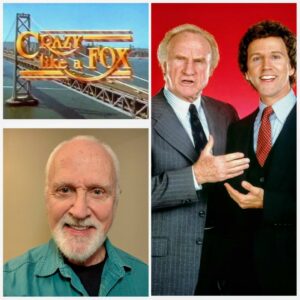
Exclusive Interview by Karen Beishuizen
Crazy Like a Fox was a mystery series set in San Francisco that aired on CBS from 1984 to 1986. Jack Warden starred as private detective Harry Fox and John Rubinstein played his son Harrison who was an attorney. He always got dragged into his father’s cases and, most of the time, against his will. The series contained various pursuits of suspects and reckless car chases in Harry Fox’s old Cadillac.
KB: “Crazy Like a Fox”: What kind of show was it?
The show was a series of imaginatively-written little murder (mostly) mysteries / comedies, but still rather complex stories, taking place mostly in San Francisco where a private investigator (played by the great Jack Warden) would be hired by different guest actors to solve them and have the perpetrator(s) apprehended. The PI’s name was Harry Fox, and he was an experienced and wily old detective with a fearless and enthusiastic personality and work ethic. His son, Harrison Fox jr. (played by me) was a successful financial attorney, married to the lovely Cindy (Penny Peyser). They had a young son, Josh (Robby Kiger), who had an excellent relationship with his grandpa. Harrison was straight-laced and careful, a loving husband, dad, and son, and a good lawyer.
But the running plot that linked the episodes was that Harry Sr. would always find ways to get Harrison reluctantly involved in the “crazy” antics that occurred during the various pursuits of suspects and evidence and bad guys. These almost inevitably included reckless car chases in Harry’s vintage Cadillac through the picturesque streets of that endlessly photogenic city. Each episode stood on its own, without cliffhangers or continuing plot lines, although there were some terrific character actors that had recurring roles.
KB: How did you get the part as Harrison Fox?
Well, I was an actor about town in those days, still am actually, and was considered for and managed to appear in many different shows on TV and in films. This role was one of the many auditions I did, and the producer/writers apparently liked what they saw. I was called in, along with a few other “finalists,” to read a second time, “for the network,” in a large room full of various CBS and Columbia TV executives and casting people and so forth. Jack Warden, already committed to starring in the show, was there too. He lived in New York and he remembered having seen me on Broadway some years earlier in a play called “Children of a Lesser God” which had won several Tony Awards. I believe he put in a good word for me, and I was offered the role.
KB: What did you like about the character?
It was pure fun. I got to play several levels. Harrison was always a bit disgruntled and irritated at having to do things far outside his comfort zone, including some whacky athletic stuff: riding a bicycle down steep stairs, and ultimately into the San Francisco Bay. Almost always having to appear in the wrong clothes, or almost no clothes at all. Trying to stay out of trouble, but invariably getting into it. Still, always supporting, admiring, and loving his dad, in spite of all the turmoil he was put through. We all had a blast shooting every episode.
KB: What did it look like on the set from getting the script to filming?
There were long days of shooting. The episodes contained quite a lot of physical action, slapstick stunts that needed to be done just right, both for comic and realistic effect. A lot of detailed dialogue unfolding the mysteries’ plot lines. So we rolled up our sleeves early in the mornings and worked often into the night. The scripts didn’t change much during shooting; the writers really concocted rather brilliant miniature mysteries that were challenging and delightful. And they hired some truly wonderful guest stars and supporting actors for each episode which brought all the new characters, especially the villains, to life with tremendous gusto and hilarity.
KB: Where was the show filmed?
We shot the pilot entirely in San Francisco on location. No studios or sets of any kind. Then when the show was “picked up” for more episodes, we started shooting all the interiors and a good number of exteriors as well at The Burbank Studios in Los Angeles which was the new name for Warner Bros. Studios where Columbia TV, which had moved out of their studios on Sunset Boulevard, was now situated. They made sets on the sound stages of the inside of Harry’s office on Market Street and the upstairs and downstairs of Harrison and Cindy’s house. We used the Warner Bros. permanent exterior city sets whenever they would be appropriate.
The producers also scouted locations in LA that could pass for a street or a building in San Francisco, so some of the exteriors were shot in those places. On the Warner Bros. back lot, a few blocks away from the main studio in Burbank, the art directors built a façade of several houses in a row that exactly matched the actual ones in San Francisco (on Clay Street, across from Alta Plaza Park, I think), among which one had been Harrison and Cindy’s home in the pilot — although the real ones were on a hill, and the back lot ones were on flat ground. Over the next two years, we would shoot five out seven (or eight) days of each episode in Burbank, completing those portions of about five or six episodes. Then we would fly to San Francisco and do the remaining two or three days on each of those same episodes on location, one after the other. It made for some confusion sometimes, trying to remember the rather complicated plot lines of a handful of shows we had shot parts of, and now had to do the intervening scenes weeks later. But it was always challenging and great fun!
KB: What was it like working with Jack Warden?
My main task on the show was not to break out laughing in the middle of takes. Jack was a man of astounding energy and humor. He was 75 when we started shooting, had a bum knee, but would show up in the makeup trailer at 5 or 6 in the morning and regale us all with his amazing stories and jokes, while the rest of us tried to slap ourselves into shape for the day ahead. Then he’d have to do a whole lot of running, up and down hills and stairs, jumping around. I’m a few years older than that myself right now, and I don’t think I could sustain the drive he had at this age! He never ran out of funny ideas, little additions or asides he would stick in during scenes. Always in a mischievous party mood. One morning we were sitting next to each other on the set waiting for the cameras and lights to be set up, and I said, “Well, today is my son’s birthday!” And he looked at me and said, “No kidding! Today is MY son’s birthday!”
We felt emotionally bonded by that odd little coincidence. One time, months later, we were shooting the ending scene of one of the episodes in Golden Gate Park in which my character Harrison had been in real danger and had been saved by Harry. After we wrapped, Jack and I were in a car on the way to the airport to fly back to Los Angeles, I noticed he had tears in his eyes. Very unusual for him. I said, “Hey, Jack. Are you okay?”. He answered that shooting the scene where his “son” was almost killed had moved him, and he couldn’t quite shake it. Even though it was part of a fictional comedy full of silly situations and jokes, that moment had taken him into his real life and his love for his real son, and imagining him in that kind of dire situation. I loved Jack, and miss him still.
KB: What is the most fondest or funniest memory you remember?
There are too many to be able to really single out just one. The show was such that it was Harry who was always pondering and thinking out loud how to put the clues together in order to figure out who were the bad guys and how to solve the crime. And I mostly just had to listen to his long speeches and then react in some way — sometimes helpfully, but often just very briefly. Jack struggled to memorize the many long speeches where he had to rattle off names, numbers, places, dates and events for that particular episode’s plot. He frequently had to go back and do them again and again because he’d get one name wrong or forgot some street or establishment he had to mention.
But ultimately he would always nail them perfectly, and it would be my turn to speak. So he would talk and talk, get all the names and places right, go on and on, and finally end his monologue with a sense of accomplishment. And my line would be something like, “But why, Dad?” And Jack would sort of stop, turn to me, and say, “Is that all you’ve got to fucking say?!?”. Or something to that effect. And I would die laughing. And the whole crew would scream with laughter. We did a great deal of laughing on the set.
KB: Do you have a favorite episode of the whole show and why this one?
To be honest, the episodes sort of blur together in my memory. Don’t forget, this was over 40 years ago, and I haven’t watched any of them since then. So I remember locations, guest actors, crazy stunts I got to do, driving with Jack in the old Caddy again and again. Probably my favorite action sequence was when I got to ride a horse at full gallop on Front Street, chasing Bo Hopkins on another horse, in (I looked it up!) “A Fox at the Races”.
Mostly, just loving the company, the wonderful writers and producers, George Schenck, John Baskin, Frank Cardea, and Roger Shulman. It was a magical time, episode after episode. Probably if I watched them all today, I might well see one and say, “Oh, yes! THAT one was the best!” But I sort of think of them all as one big, fantastic, funny story. I have heard that they are all available to stream on Netflix right now! I definitely plan to take a peek before too long!
KB: Looking back now, would you have played Harrison differently?
I probably would do pretty much what I did then. I’m afraid (having not seen them since we shot them) that if I saw them now, I would most likely be appalled at some of the overacting I doubtlessly allowed myself to do. There is always a fine line, when playing a comic moment that is absolutely meant to be — needs to be — hilarious for the audience, but dead serious for the characters in the story, where going too far trying to be funny belies and undermines the seriousness and realism.
Or, conversely, playing it too close to the vest and too down-to-earth might be more realistic and credible, but might fail to give the moment the comic underpinning it wants. So I do not doubt that there were times when I didn’t manage that balance perfectly. But overall, Harrison and I were pretty comfortable with each other.
KB: How do you explain that the show is still so beloved even after 40+ years?
Well, I am pretty picky myself, and I loved the scripts. It was really quite an achievement for the writers to come up with a fully-realized hour-long murder mystery every week, and make it unpredictable and funny. But they did it, and we actors, and all the great directors we had, brought as much truth and craziness to it as we knew how. After all, if you get to watch crazy Jack Warden and your background is San Francisco, what’s not to love?
Click Here to Order Boxing Interviews Of A Lifetime By “Bad” Brad Berkwitt